

From choosing the right piece of land to moving in. Everything you need to know about creating your dream home in California’s wine country.
Building a custom home in Napa Valley is one of the most rewarding things you can do with a piece of land. Few places anywhere offer this combination of climate, beauty, and lifestyle. And the architecture here should live up to all of it.
But building in wine country is a different animal than building in most of California. Between fire-resistant construction requirements, steep hillside lots, preservation ordinances, and the particular demands of vineyard living, the process has a handful of wrinkles that can catch people off guard if they haven’t been through it before.
At RG/Architecture, we’ve been designing custom homes in the Napa Valley for more than 50 years. My father Robert started this firm, and between the two of us we’ve walked hundreds of families from first-spark-of-an-idea through move-in day. This guide is five decades of experience distilled into a practical roadmap for anyone thinking about building their dream home in wine country.
Why Build Custom in Wine Country?
When you buy an existing home, you’re inheriting someone else’s compromises. In a region this visually stunning and climatically unique, those compromises can be hard to live with. Windows that miss the vineyard view. A kitchen that wasn’t built for real entertaining. An older home that doesn’t have modern fire safety features. You can renovate, sure. But sometimes starting fresh is the smarter play.
A custom home lets you design around the specific qualities of your land. You can orient your living spaces to catch the morning light across the Mayacamas. You can frame a particular vineyard view from your kitchen island. You can create the kind of seamless indoor-outdoor flow that makes the most of 260-plus days of sunshine.Custom building also solves practical problems that are uniquely important here. Wildfire resilience can be designed in from the foundation up, which is far more effective (and less expensive) than retrofitting an older structure. You can incorporate the latest Title 24 energy standards, including mandatory solar panel systems, and choose materials specifically suited to this warm, dry climate.
Understanding the Costs Of Building a Custom Home
This is the first question everyone asks, so let’s get right to it. The honest answer is that cost depends significantly on your site, your design complexity, your material choices, and how high-end you want to go with finishes. But we can give you some idea of realistic ranges based on what we’re seeing in the current market:
Current Construction Costs in Wine Country
As of early 2026, custom home construction costs in the Napa Valley generally break down like this:
| Build Level | Cost per Sq. Ft. | 3,500 Sq. Ft. Home |
| Standard Custom | $400–$500 | $1.4M–$1.75M |
| High-End Custom | $500–$700 | $1.75M–$2.45M |
| Ultra-Luxury / Estate | $700–$1,000+ | $2.45M–$3.5M+ |
These figures are construction costs only and don’t include land, which varies dramatically in the valley. A smaller in-town lot might run $500,000. A vineyard parcel with acreage can be several million.
What Drives Costs Up in Wine Country
A few things make building here more expensive than most of California. Wildfire-resistant construction is a big one. Chapter 7A of the California Building Code (now consolidated into the 2025 California Wildland-Urban Interface Code, effective January 2026) requires specific materials for roofing, siding, vents, windows, and decking in Fire Hazard Severity Zones. Most of Napa County falls within these zones. The materials perform beautifully and they’re worth it for the protection, but they’re not the cheapest options on the shelf.
California’s solar mandate under Title 24 requires all new single-family homes to include photovoltaic systems sized to the home’s annual energy use. This adds upfront cost, but it dramatically reduces long-term energy bills and may qualify for the 30% federal Investment Tax Credit. Battery storage systems, while not yet mandatory for single-family homes, can reduce required solar capacity by 25% and provide backup power during outages.
Other cost drivers include hillside site prep (grading, retaining walls, and specialized foundations for sloped lots), extended utility runs for rural vineyard parcels, well and septic systems for properties outside city services, and Napa County’s thorough environmental review process.
How Architect Fees Work
Architectural fees for custom homes in Napa Valley typically range from 10% to 15% of total construction cost, depending on project complexity and what’s included in the scope. That investment covers the full journey from first sketches through construction oversight.
Working with a local architect is especially important here because wine country building involves layers of regulation and site-specific challenges that architects from outside the area tend to underestimate. Someone who knows Napa County’s planning department, understands the local soils and seismic conditions, and has solid relationships with trusted contractors can save you real time and money. That local knowledge pays for itself many times over.
Choosing the Right Land
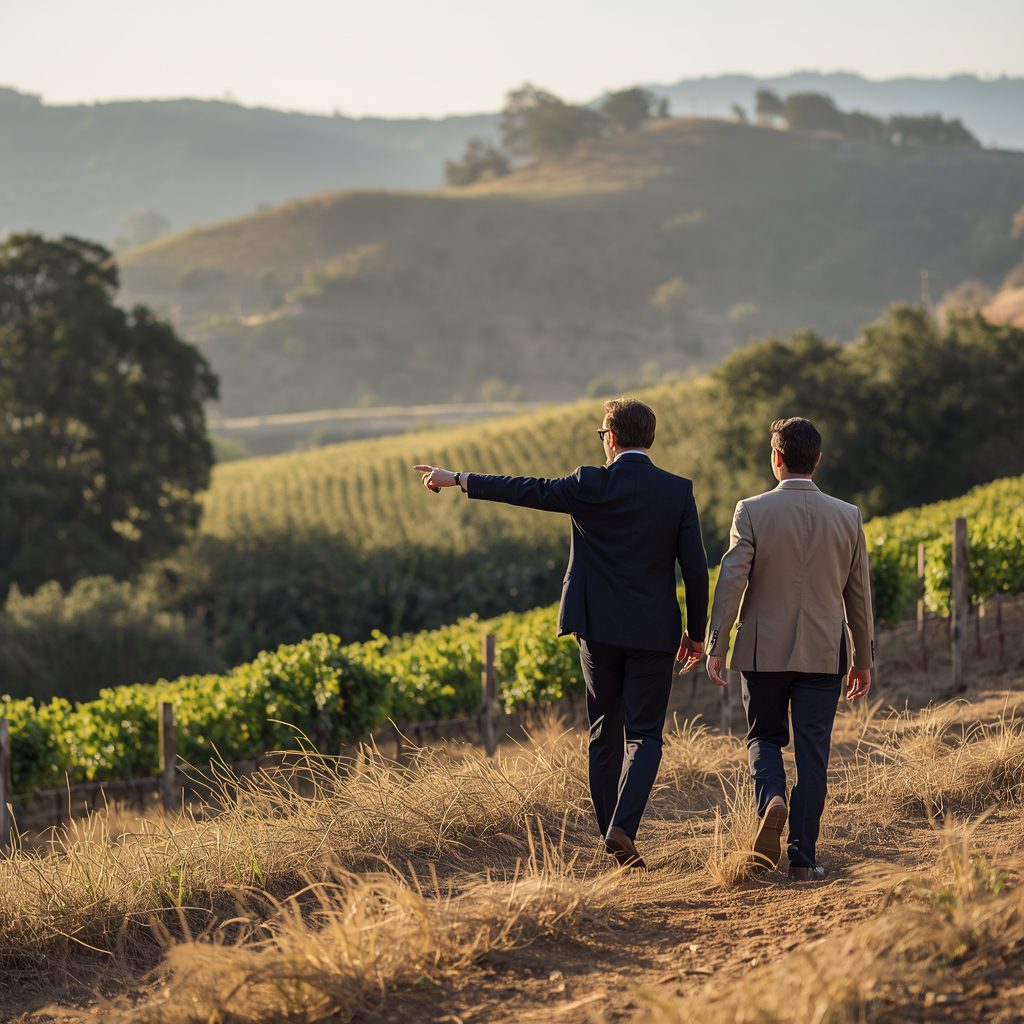
If there’s one decision that shapes everything else, it’s this one. In wine country, the land doesn’t just determine your address. It shapes the architecture itself.
What to Look at Before You Buy
Topography and buildable area. Napa Valley is defined by its terrain. A steeply sloped lot might offer incredible views but require extensive grading, retaining walls, and a specialized foundation, all of which add cost and time. We always recommend bringing an architect out to walk any parcel before you make an offer. It’s a small investment that can save you from an expensive surprise.
Fire Hazard Severity Zone designation. Check your property’s classification using CAL FIRE’s FHSZ maps. Lots in Very High severity zones trigger the full suite of wildfire-resistant construction requirements, plus defensible space mandates of 100 feet or more around the structure.
Water and septic. Rural parcels in Napa County often need private wells and septic systems. Soil percolation tests and water availability studies are a must before purchasing. Municipal water and sewer are available in the cities of Napa, St. Helena, Calistoga, and Yountville, but the service area boundaries can be tricky. Don’t assume you’re connected just because you’re nearby.
Zoning and agricultural preserve restrictions. Much of Napa County is zoned Agricultural Preserve or Agricultural Watershed, which limits lot coverage, building height, and sometimes total buildable square footage. Some parcels require 40 or even 160 acres for new development. This is wine country. The vineyards come first in the eyes of the county, and the zoning reflects that.
Views and orientation. Where the building pad sits relative to the sun’s path and the best views will shape the entire design. A south-facing slope with western vineyard views creates completely different architectural possibilities than a north-facing hillside looking out over the valley floor. Both can be spectacular, but the design approach is very different.
The Building Process, Step by Step
From first conversations to handing over the keys, building a custom home in the Napa Valley typically takes 18 to 36 months. Here’s a realistic look at the major phases:
| Phase | Duration | Key Activities |
| 1. Land & Pre-Design | 1–3 months | Site selection, surveys, soil tests, feasibility |
| 2. Architecture & Design | 3–6 months | Schematic design, development, construction docs |
| 3. Permitting & Approvals | 2–6 months | Plan review, county/city approvals, environmental |
| 4. Construction | 12–18 months | Foundation through final finishes |
| 5. Final Inspections | 1–2 months | Occupancy permit, punch list, landscaping |
Total timeline: roughly 19 to 35 months. Complex projects with hillside sites, environmental review, or agricultural preserve approvals can push past that range. We’d rather set realistic expectations up front than overpromise on speed and disappoint you later.
Phase 1: Pre-Design and Site Analysis
Before we draw a single line, we spend time getting to know your property. That means reviewing survey documents, soil and geotechnical reports, existing vegetation (heritage oaks are protected in Napa County, and for good reason), and utility access. We dig into zoning, setbacks, and any deed restrictions that might affect what you can build.
This is also when we have the most important conversations with you: How do you actually live? How do you entertain? What brought you to wine country? Do you want a home that tucks into the hillside or one that makes a bold contemporary statement? These discussions form the foundation of everything that follows. Get them right and the design practically draws itself.
Phase 2: Architecture and Design
Design unfolds in three stages. Schematic design explores the big ideas: overall form, spatial relationships, how indoor and outdoor spaces connect. Design development refines those ideas with specific materials, structural systems, and engineering coordination. Construction documents produce the detailed drawings and specifications your contractor will actually build from.
In wine country, this phase involves close attention to how the home relates to the landscape. We think about sun angles through every season, wind patterns (important for both outdoor comfort and fire safety), and sight lines to the valley, mountains, and vineyards. The best homes here don’t just sit on the land. They belong to it.
Phase 3: Permitting and Approvals
Napa County handles building permits through its Online Permit Center, with plan review timelines that vary by project complexity. For a custom home, expect the initial review to take about 21 to 28 business days, with additional time for correction cycles. Most projects go through two or three rounds before the permit is issued.
Depending on where your property sits and how it’s zoned, you may also need signoffs from the Planning Division, Environmental Services (for well and septic), Napa County Fire, and sometimes the Department of Fish and Wildlife if there’s sensitive habitat involved. An architect who knows these agencies and has been through the process before can coordinate concurrent reviews instead of letting them stack up one after another. That alone can save you months.
| A Note on the 2025 California Building Codes |
| California adopted updated building codes effective January 1, 2026, including a new consolidated Wildland-Urban Interface Code (Title 24, Part 7). If you’re planning to build, it’s worth getting familiar with these changes early. They affect material choices, venting requirements, and defensible space standards. Your architect should be walking you through the applicable code requirements from day one, not surprising you with them at the permit counter. |
Phase 4: Construction
With permits in hand, building begins. A typical custom home in Napa Valley takes 12 to 18 months to construct, depending on size, complexity, and weather. The work moves through site prep and grading, foundation, framing, roofing, exterior finishes, rough-in for mechanical, electrical, and plumbing systems, insulation, interior finishes, and finally fixtures, appliances, and landscaping.
During construction, your architect is your advocate on the job site, conducting regular visits, reviewing submittals and shop drawings, answering questions from the contractor, and making sure the design intent is actually making it into the built work. This construction administration role is one of the most valuable things an architect does, and it matters even more on complex wine country projects where there’s a lot that can go sideways without experienced oversight.
Phase 5: Final Inspections and Move-In
The home stretch. Final building department inspections, a detailed punch list walk-through to catch any remaining items, final landscaping, and the certificate of occupancy. For homes in wildfire zones, the final inspection includes verification that all required fire-resistant materials and methods were used, and that defensible space requirements are met. Then the fun part: you move in.
Designing for Wine Country Living
Architecture in the Napa Valley has its own vocabulary. After five decades of designing homes here, we’ve landed on a few design principles that consistently produce homes people love coming back to every single day.
Indoor-Outdoor Integration
Wine country’s climate practically demands homes that blur the line between inside and outside. Large sliding or folding glass wall systems, covered outdoor living rooms, al fresco dining terraces, and kitchen pass-throughs to outdoor cooking areas are all signatures of thoughtful wine country design. The goal is to make your outdoor spaces feel like natural extensions of the interior, usable from March through November and comfortable even beyond that.
The Wine Country Kitchen
People who live in the Napa Valley tend to be serious about food and entertaining. Kitchens here serve as the social center of the home, and they need to perform at a higher level than most residential kitchens. That means ample counter space, professional-grade appliances, a generous walk-in pantry, and a layout that lets multiple cooks work at the same time without bumping into each other. A direct connection to outdoor dining, whether through a pass-through window or an adjacent covered terrace, is almost non-negotiable at this point.
Fire-Resistant Design That Still Looks Like a Home
Fire-resistant construction does not have to look institutional. Modern ignition-resistant materials include some genuinely beautiful options: fiber cement siding that replicates the look and texture of real wood, Class A standing-seam metal roofing, tempered and insulated glass systems, and ember-resistant vent technologies that are nearly invisible once installed. With thoughtful design, a home can meet or exceed every wildfire code requirement while looking every bit the place you imagined when you first fell in love with that piece of land.
Sustainability and Energy Performance
California’s Title 24 energy code already pushes new homes toward high performance. We like to go further, incorporating passive solar strategies that take advantage of the predictable sun angles here, high-efficiency heat pump systems, serious insulation and air sealing, and drought-conscious landscaping. The mandatory solar PV system becomes a feature, not a burden, when it’s designed into the roof from the start rather than bolted on at the end.
Common Mistakes to Avoid When Building a Custom Home
Buying land without professional input. That stunning hilltop parcel might have impossible access, no water, or soil conditions that triple your foundation costs. Always bring an architect and a civil engineer into the conversation before you close.
Underestimating the timeline. Two to three years is realistic for most custom homes in Napa Valley, start to finish. Rushing the design or permitting process leads to expensive mistakes and change orders during construction. Patience pays.
Treating fire safety as an afterthought. Wildfire-resistant design is most effective and most economical when it’s baked in from the very first concept. Trying to bolt fire safety onto a finished design always costs more and usually compromises something.
Hiring the builder before the architect. The architect’s construction documents define the scope of work your builder will bid on. Without complete documents, you’re comparing apples to oranges across bids and setting yourself up for surprises. Get the design done first, then put it out for competitive bids.
Forgetting the landscape. The Napa Valley has a strong visual character: rolling hills, vineyard rows, heritage oaks, seasonal creek beds. The best homes here work with that landscape, not against it. Budget for thoughtful site design and professional landscaping from the beginning. It makes a bigger difference than most people expect.
Why a Local Architect Matters More in Wine Country
You might be able to build a house without an architect in a lot of places, but wine country isn’t really one of them. The combination of complex topography, strict fire codes, agricultural zoning, environmental protections, and the high expectations of luxury living creates a web of challenges that genuinely requires professional design help.
A good wine country architect acts as your translator. Between your vision and the realities of the site. Between how you want to live and the codes that govern what gets built. And between the design on paper and the contractors who bring it to life. Over 50 years, we’ve learned that the homes our clients love most aren’t necessarily the ones with the biggest budgets. They’re the ones where the design process was thorough, collaborative, and grounded in real knowledge of this place.